A paid livestream can turn into a technical nightmare when a supposedly secret event link reaches a public group chat minutes before the show starts. Private livestream access solves that problem by putting authentication between the viewer and the actual video stream, rather than treating a URL as proof of payment.
The strongest setups combine short-lived tokens, origin controls, account authorization, and encryption instead of relying on one security feature. AWS documentation similarly recommends tokenization and authorization for protecting high-value streaming content.
1. Private Livestream Access Starts With Tokenized URLs and Domain Restriction
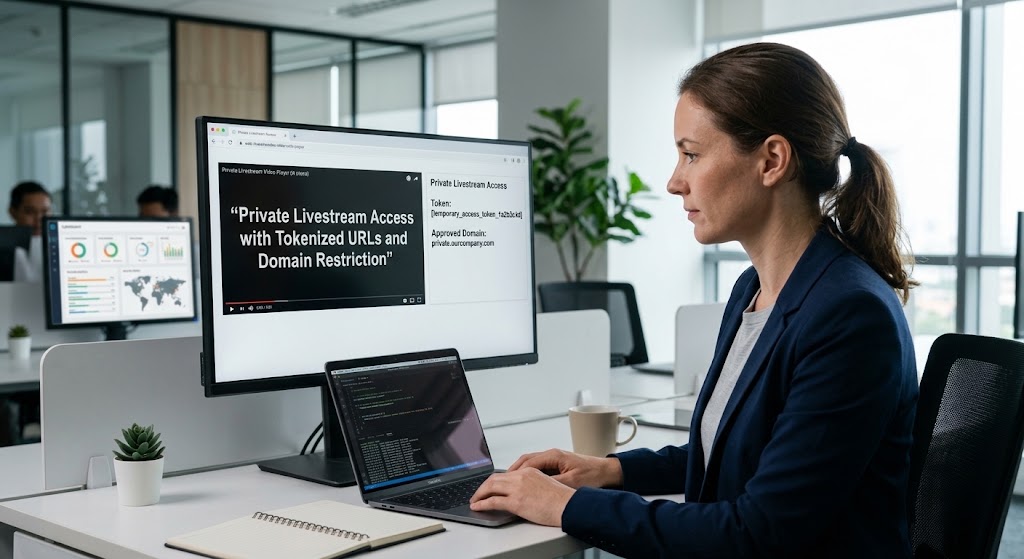
A private event should never depend on a permanent playback URL that anyone can copy and paste. A better architecture checks whether the viewer is entitled to watch before issuing temporary credentials for playback. This creates a much smaller attack window if someone shares the link during the event.
Why a Tokenized URL Beats a Normal Streaming Link
A tokenized URL contains a signed credential that can carry rules such as expiration time, identity, or access restrictions. When the viewer requests the stream, the backend verifies the token before allowing playback, which is fundamentally different from hiding a URL and hoping nobody discovers it. AWS describes this approach through signed URLs, cookies, and JWT-based authorization, while Mux uses signed playback tokens for the same basic purpose.
For a VIP event, the practical rules should be:
- Generate access only after payment or entitlement is confirmed.
- Give the token a short lifetime around the event window.
- Keep signing keys on the server, never inside front-end JavaScript.
- Revoke or invalidate access when suspicious activity is detected.
Domain Restriction Stops Unauthorized Embedding
Even a valid stream can become a problem if another website embeds the player and attracts viewers without permission. Domain restriction limits where the browser is allowed to request or display the stream, reducing unauthorized embedding. Amazon IVS, for example, supports origin enforcement for private channels so playback can be limited to approved domains.
This matters particularly for ticketed events because a leaked embed can be more damaging than a leaked URL. Someone may not need to distribute the original link at all if they can simply place your player on another page.
Signed URLs and Signed Cookies Have Different Jobs
For a single restricted file, signed URLs are straightforward because the authorization travels with the request. For video delivered through multiple HLS segments, signed cookies can be useful because they can authorize access across multiple restricted objects without changing every URL. CloudFront explicitly recommends considering signed URLs for individual files and signed cookies for groups of restricted files.
Best recommendation: use short-lived signed playback authorization for most paid events, then add origin enforcement when unauthorized embedding is a realistic threat.
2. Paywall Security Needs More Than a Login Screen
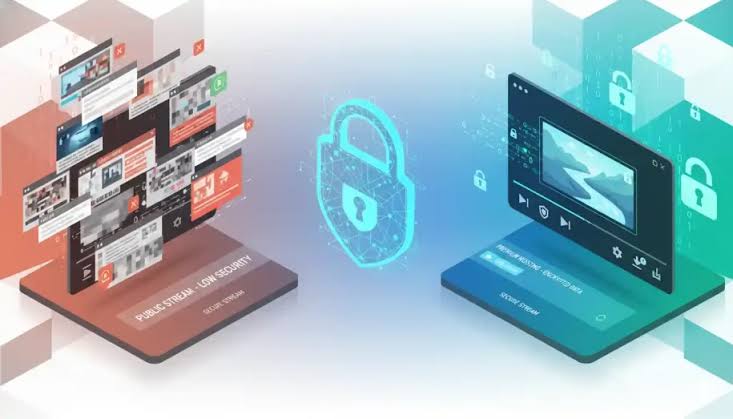
A username and password can confirm who bought a ticket, but they don’t automatically protect the video after playback begins. Strong paywall security separates entitlement from media delivery, so the application decides whether someone can watch before the streaming infrastructure serves the content. This is especially important when hundreds or thousands of customers access the same event simultaneously.
Build Authorization Around the Purchase
The clean flow is simple:
- Viewer purchases an event ticket.
- Your backend records the entitlement.
- Viewer signs in or presents a valid session.
- Backend checks the entitlement.
- Backend generates temporary playback authorization.
- The player receives the stream only after validation.
Amazon IVS documents a similar private-channel workflow where the application backend decides whether a viewer is authorized and then generates a signed JWT for playback.
This architecture also makes refunds, cancellations, account bans, and access expiration much easier to manage.
DRM Protection Is the Next Layer
DRM protection becomes relevant when the content itself has high commercial value or the organizer wants stronger control over decryption keys. Unlike simple URL protection, DRM encrypts the media and uses a protected mechanism to deliver decryption credentials to authorized devices. AWS notes that systems such as Apple FairPlay, Google Widevine, and Microsoft PlayReady can provide stronger content protection, although multi-DRM support increases implementation complexity.
DRM is worth considering for:
- Premium concerts and sports
- Paid conferences
- High-value masterclasses
- Corporate broadcasts
- Exclusive performances with licensing restrictions
It still isn’t magic. A viewer can potentially record their screen because the content eventually has to become visible to the authorized viewer.
Watermarking Adds a Deterrent DRM Cannot Provide Alone
For expensive events, add visible or forensic watermarking where the platform supports it. A viewer-specific identifier can make redistribution riskier because leaked footage may be traceable to an account. The goal isn’t to promise impossible piracy prevention but to raise the cost of abuse and improve accountability.
A useful security stack therefore looks like this:
- Authentication → Who is the viewer?
- Entitlement check → Did they pay?
- Tokenized playback → Are they currently authorized?
- Domain restriction → Where can playback occur?
- DRM protection → Can the media keys be protected?
- Watermarking → Can leaked footage be traced?
For readers building a simpler livestream workflow before adding these advanced layers, this guide to solving livestream access problems before an event starts is a useful complementary reference.
3. Choose the Right Security Stack Without Overengineering the Event
Not every livestream needs enterprise DRM. A small paid workshop with 50 viewers has very different risk and infrastructure requirements from a globally licensed concert. The smart approach is to match the protection level to the financial value of the content, expected audience size, and consequences of unauthorized redistribution.
Basic Paid Event Setup
For a small event, start with:
- Authenticated accounts.
- Payment verification.
- Short-lived playback tokens.
- HTTPS everywhere.
- Basic logging and access monitoring.
This is usually enough to prevent casual link sharing and unauthorized embedding without creating an unnecessarily complicated system.
Premium VIP Event Setup
For high-value broadcasts, move toward:
- Short-lived tokenized playback
- Domain or origin enforcement
- Geographic restrictions when appropriate
- DRM protection
- Viewer-specific watermarking
- Rate limiting and suspicious-session detection
- Rapid token revocation
AWS specifically recommends temporary tokenization schemes such as signed URLs, signed cookies, or JWTs for approved front-end applications.
The Biggest Mistake Is Treating the URL as the Security Layer
A private-looking URL isn’t a security system. If the playback endpoint works indefinitely without verifying authorization, the link can eventually escape the original audience.
The stronger model is identity → entitlement → temporary authorization → protected playback. That gives the organizer control before and during the event instead of discovering the leak after the audience has already multiplied.
Final Recommendation
For most paid VIP livestreams, I’d start with short-lived playback tokens plus domain restriction. Add DRM when the content has substantial licensing, resale, or piracy risk, because DRM introduces additional device compatibility and implementation complexity.
The key takeaway is simple: don’t try to make a secret URL impossible to share. Make the shared URL useless without valid authorization.
Q&A
Can a tokenized URL completely stop livestream piracy?
No. It can strongly control access to the stream, but it cannot guarantee that an authorized viewer won’t screen-record the content. DRM, watermarking, monitoring, and legal enforcement are needed when piracy risk is high.
How long should a private livestream token remain valid?
For a single event, keep the validity window as short as the viewing experience reasonably allows. A token that expires shortly after the event is safer than a permanent credential that can circulate for weeks.
Is DRM necessary for every paid livestream?
No. For smaller events, authentication, entitlement checks, short-lived tokens, and origin controls may provide a better cost-to-security balance. DRM becomes more compelling when the content has significant commercial or licensing value.

Minh Thư Đặng has worked in virtual event support for education companies, professional associations, and regional conferences. Her responsibilities included managing registrations, sending access instructions, assisting international attendees, and resolving login problems during live sessions. She now writes straightforward guides about joining webinars, using digital tickets, entering private broadcasts, and participating in online events without confusion.